
The Wildlife Trusts have raised £20.7m of the £30m needed to buy the rest of the Rothbury Estate, and the clock runs out in September. What happens if they miss it.
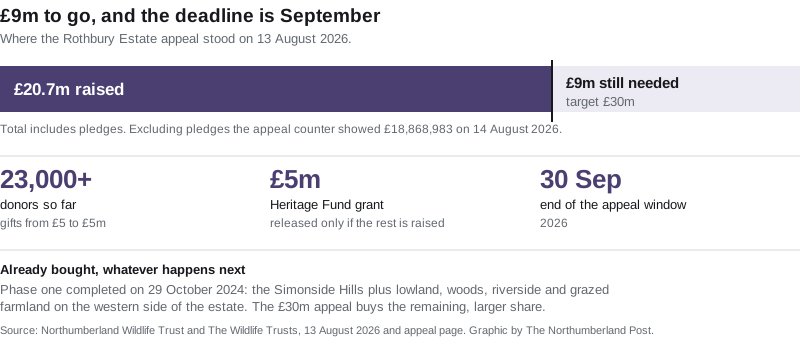
The appeal to buy the rest of the 9,500-acre Rothbury Estate has passed £20.7m and needs another £9m, with the purchase deadline falling in September. Northumberland Wildlife Trust and The Wildlife Trusts announced the milestone on Thursday 13 August, saying the money has come from more than 23,000 donors and that the campaign now needs “a momentous final effort”.
The £30m target is the largest single fundraising appeal in the history of The Wildlife Trusts, a federation of 46 charities. It is backed by Sir David Attenborough. What it buys is the second and larger tranche of an estate that had been in Percy family ownership for more than seven centuries, and which the charities describe as the largest piece of land to come to market in England in over 30 years.
The part that is already bought, and the part that is not
This matters for anyone who walks the Simonside ridge, so it is worth being precise about it. The purchase is in two phases, and phase one is done.
The trusts completed the first tranche on 29 October 2024. It covers the Simonside Hills together with a mixture of lowland, woods, riverside and grazed farmland on the western side of the estate. They are contractually barred from saying what they paid, and the FAQ says that phase was carried by individuals who “lent or given several million pounds towards it”.
The remaining land is the bigger share of the estate’s value, and that is what the £30m appeal is for. The trusts are explicit that the money is not only the land: it covers “the land costs, other associated fees, management costs, surveys and a new staff team”.
They are equally explicit about the fallback. If the appeal falls short, the charities keep the first tranche, so Simonside itself is not in question either way. What is in question is everything else, and the 13 August statement spells out the alternative: there are “permissions in place for commercial forestry on large parts of the Estate should the appeal be unsuccessful”.
Why the deadline is a hard one
There are two dates in play and they are not the same length of rope.
The appeal’s own framing is to raise £30 million by September 2026. Sitting inside that is the £5m awarded by The National Lottery Heritage Fund, announced in March, which took the total past halfway at the time. That grant is conditional: to unlock it, the charities “must raise the remainder of the funding by the end of September 2026”. So a fifth of the target is contingent on hitting the rest of it.
The 13 August release describes “just over two months remaining”. Craig Bennett OBE, chief executive of The Wildlife Trusts, put it as: “We’ve still got a bit of a climb to get to the summit, but the thousands of messages of personal support show just how strongly people feel about The Rothbury Estate.”
One caveat on the headline number. The £20.7m includes pledges as well as banked money. The live counter on the appeal page showed £18,868,983 raised excluding pledges at the time of writing, against £20,773,837 with them counted.
Where £20.7m comes from
Donations have ranged from £5 to £5 million. The recent ones named in the announcement give a fair picture of the mix:
- The Samworth Foundation, an East Midlands grant-maker, gave £650,000.
- Ringtons, the Newcastle tea and coffee firm, gave £50,000, used to seed a public match-funded appeal.
- The Cycling Cranks, a Northumberland cycling club, gave £1,000 and are advising the trusts on how access to the estate might change.
That last one is the useful signal. The charities have said repeatedly that they intend to “preserve and enhance public access and recreation opportunities”, and they are taking advice from people who actually use the ground.
What it would mean on the ground
Farming is the part local readers ask about first. The estate has tenant farmers, and the trusts’ position is that farming “has been an integral part of the history of the Estate for centuries” and will remain “at the heart of our future plans”. Mike Pratt, chief executive of Northumberland Wildlife Trust, said in March that the trust is “already working closely with tenant farmers on parts of the Estate” on nature-friendly methods that keep farms productive.
Beyond the boundary, the estate is meant to be the middle of something much larger: a 40-mile nature corridor running from Druridge Bay on the coast to Kielderhead at the Scottish border, covering around 210,000 acres of land in different ownerships.
The buyer, for now, is the Royal Society of Wildlife Trusts, which is handling the acquisition because it holds the national donor relationships. The long-term plan is a new charitable trust to own and manage the estate, with trustees drawn from both the national body and Northumberland Wildlife Trust.
What it means for you
Simonside is safe regardless. The hills, and the woods, riverside and grazed farmland on the western side, were bought outright in October 2024. Nothing about the September deadline changes access there. Cragside, a short distance away at Rothbury, is a separate National Trust property and is not part of this at all: prices and opening are on our things to do in Northumberland page.
If you want to give, give before the end of September. Donations after the deadline do not help unlock the Heritage Fund’s £5m. The appeal takes card payments online, and also accepts cheques and bank transfers, with the details published on the appeal page. Northumberland Wildlife Trust is registered charity number 221819.
Check the counter, not the headlines. The live figure on the appeal page is the one that moves daily, and it is shown twice: with pledges and without. The gap between the two is roughly £1.9m at the moment, which is real money that has been promised but not yet banked.
If you farm, rent or hold rights on the estate, the consultation is the route in. The trusts say consultation began with tenants after phase one completed and is meant to continue through phase two. Enquiries go through Northumberland Wildlife Trust rather than the county council, since this is a private land sale and not a planning matter.
Update, 27 September 2026: Northumberland Wildlife Trust’s FAQ now gives the completion date as the end of October 2026, and says its trustees have agreed to take out a low-interest loan, if needed, to cover any gap. The total stood at £27.4m including pledges on 27 September. Read our latest report.
Have your say