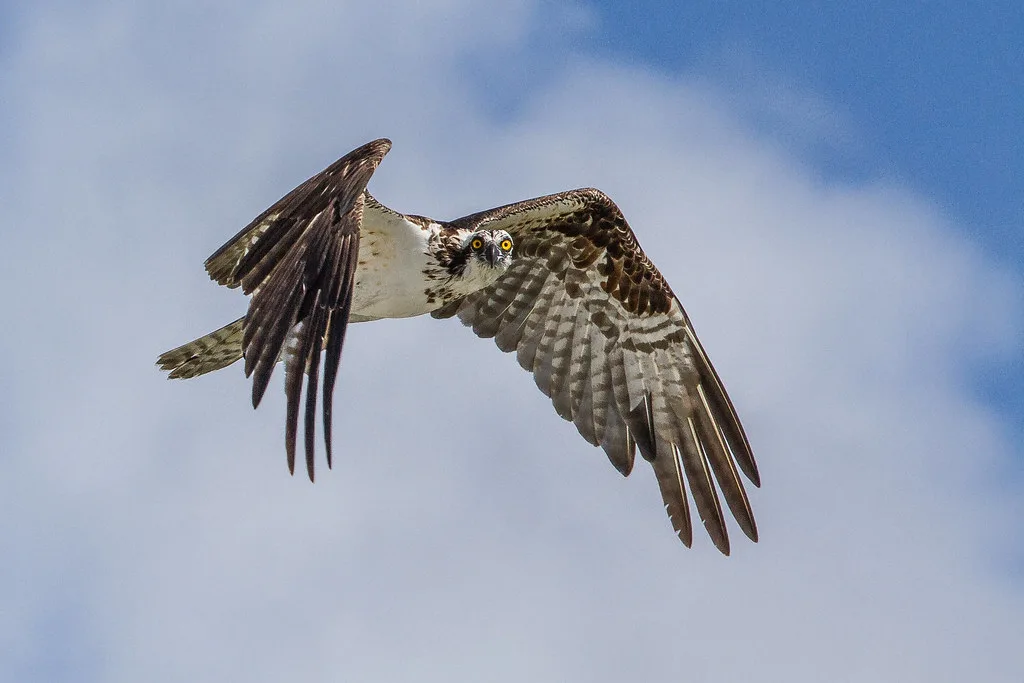

A male chick named Kielder flew from Nest 12 on 6 August, the 150th osprey to fledge in Northumberland since the birds came back in 2009. Where the count stands, and how to see them before they leave.
The 150th osprey chick to fledge in Northumberland since the species returned to breed in 2009 took its first flight from Kielder Forest on the morning of Thursday 6 August. The bird, a male ringed 1K1 and named Kielder, left the “Lord Robinson” nest, known to the project as Nest 12, at 07.56, according to the Kielder Osprey Project’s own record of the flight. The partnership behind the project announced the milestone on Wednesday 12 August.
Ospreys were absent from Northumberland for more than two centuries before a single pair raised three chicks at Kielder in 2009. Seventeen summers later the forest holds several occupied nests, and the milestone bird carries the forest’s own name in the year Forestry England marks 100 years since the first trees were planted at Kielder in 1926.
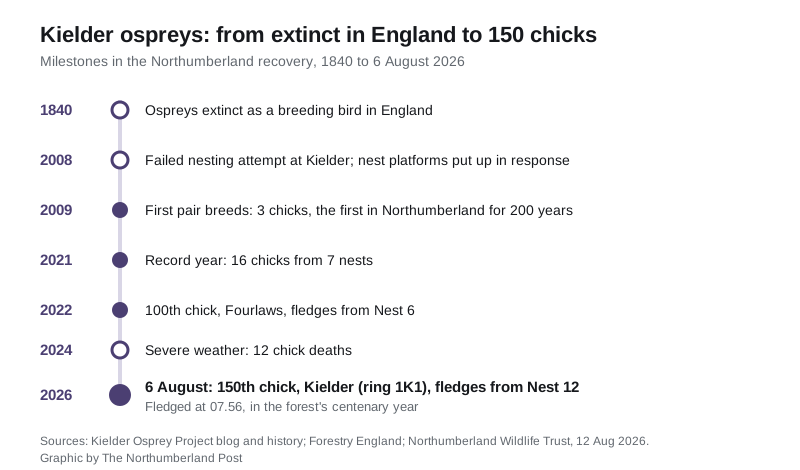
How the count got to 150
The project’s volunteers keep a nest-by-nest record of every egg, hatch, ringing and first flight, and it is that log which identifies 1K1/Kielder as the 150th successful fledge, as the blog put it on 11 August: “A careful record has been kept of fledging times/dates. It shows that the 150th successful fledge since ospreys recolonised Kielder Forest in 2009 was 1K1/Kielder from the Lord Robinson nest, Nest 12.”
The staging posts along the way, from the project’s own history and Forestry England’s account:
- 1840: ospreys became extinct as a breeding bird in England, driven out by egg and skin collectors and by shooting to protect fish, according to the project’s osprey facts page. They bred again in Scotland from 1954 and in England from 2001, at Bassenthwaite in the Lake District.
- 2008: two young birds tried and failed to nest at Kielder, and the Forestry Commission put up nesting platforms around the forest in response, the project’s history records.
- 2009: the first pair, both unringed, raised three chicks.
- 2021: seven pairs raised young, a record 16 chicks fledged, and for the first time in at least two centuries some of those chicks had fathers who were themselves hatched at Kielder, Forestry England says.
- 2022: the 100th chick, a female ringed 1B2 and named Fourlaws, fledged from Nest 6.
- 2024: a bad year; Forestry England records 12 chick deaths in severe weather.
- 6 August 2026: the 150th, 1K1/Kielder, from Nest 12.
The project itself notes that the count of chicks fledged is not quite the same as the count that made it away on migration. Its home page puts the number of young ospreys that left on migration between 2009 and 2025 at 130, because some fledglings are lost in the weeks between first flight and departure.
This summer’s nests
The blog’s posts through July and August record first flights from six nests this year: three young from Nest 1A (Kilham, Knowesgate and Kyloe), two from Nest 7 (Kirkharle and Kirknewton), two from Nest 2 (Keenley on 6 August and Kimmer on 1 August), two from Nest 12 (Kielder and his sibling Kershope), three from Nest 10 and Kellah from Nest 5A. Chicks at Kielder are ringed with a blue ring and given a name beginning with the year’s letter, K for 2026, usually a Northumberland place name.
As of the project’s update on 15 August, two more were still to be confirmed: Kevelin, the underdeveloped younger chick on Nest 5A, who had not been seen at the nest since Thursday, and the single chick on Nest 4, which is hard to observe and has no working camera. The volunteers were due to check again on Monday.
The season is now turning. Ospreys are being seen on migration through the UK, and the blog notes that Nest 7’s juvenile Kirkharle had not been on camera since 12 August and may already have gone. Adults typically leave in late August and September, and the young follow on their own, a journey the project puts at around 5,000 miles to sub-Saharan Africa. Ringed Kielder birds have been photographed in Senegal in past winters, and several are now known to be breeding in Scotland, Cumbria and Wales.
Who runs it
The Kielder Osprey Project is a partnership between Forestry England, Northumbrian Water, Northumberland Wildlife Trust, Kielder Trust, Wild Intrigue and Calvert Kielder. Alex MacLennan, Forestry England’s recreation and public affairs manager, said: “It’s a great achievement to reach 150 successfully fledged chicks since 2009, their return each year to breed right here in Northumberland is a real calendar highlight. Even after so much success each year brings its own challenges in weather, predators and more so this is a very special milestone.”
Elizabeth Blair, director of Kielder Trust, said the 150th fledgling being the forest’s namesake in its centenary year “makes it even more special”.
A Crowdfunder appeal is running to pay for better nest cameras and livestreaming and for new nesting platforms, with the British Airways Better World Community Fund matching individual donations up to £250, according to the announcement.
What it means for you
You can still see them, for a few weeks. There is no public access to any nest and disturbing breeding ospreys is an offence, but the birds fish the open reservoir. The project’s advice is to watch from the dam, Tower Knowe Visitor Centre, Leaplish Bay at Kielder Waterside and the weir at Bakethin, early morning and early evening being the most productive times, and to look along the shallow edges of the water. Take binoculars.
Osprey Watch has closed for the year. The staffed viewing cabin at Tower Knowe, run by Northumberland Wildlife Trust volunteers with scopes on Nest 7 and a 4K nest camera feed, ran from 4 April to 15 August. If you want that experience, plan for next spring; the birds usually return in the last week of March or early April.
The nest camera is still online. The Nest 7 webcam is linked from the project’s site, and the volunteers post most days while any bird remains.
Kielder is a long drive from most of the county. The reservoir sits in the far north west, beyond Bellingham, on single-carriageway roads. Check our Northumberland roadworks and travel page before setting off, and if you are making a day of it, the things to do in Northumberland page covers what else is on in the west of the county.
Have your say