
Bathing has resumed south of the Dave Stephens Centre, but the beach north of it stays closed while the Environment Agency investigates creosote in the sand.
Part of Blyth Beach is still closed going into the bank holiday weekend.
Updated 8 October: lab tests have now confirmed creosote, and the council names a former timber treatment works next to the beach, which closed around 1980, as the likely source. The north end is still closed. Read the latest.
Restrictions on land access and on bathing remain in place north of the Dave Stephens Centre, and at the Hole in the Wall entrance to the beach. Bathing south of the Dave Stephens Centre has been allowed again since the middle of the month.
Preliminary analysis of Environment Agency samples suggests creosote contamination in the affected area, according to the council’s latest update, published on 20 August and revised on 21 August. The Environment Agency, Northumberland County Council and the Port of Blyth are still working out where it came from.
What is restricted right now
From the council’s own update and its service alerts page:
- land access is restricted in the affected area, north of the Dave Stephens Centre
- bathing is restricted in the same area
- there is a temporary restriction at the Hole in the Wall entrance to the beach
- bathing south of the Dave Stephens Centre has resumed, following sampling and a review
The council asks visitors to follow the signage on site. It has not given an end date for the restrictions, and says it will update when more information is available.
The Environment Agency has it logged as an open incident
The pollution appears on the Environment Agency’s own bathing water register, not just in the council’s press notices. That record is the harder evidence, and it was still open when we checked it on 27 August.
The register entry for Blyth South Beach lists one open pollution incident:
- incident reference 04600-20260811-171000
- national incident reference 02544146
- classified as oil or fuel
- recorded at 17:10 on 11 August 2026
Blyth South Beach has been a designated bathing water since 1988. Its most recent annual classification, for the 2025 season, is Excellent, the top of the four grades.
What creosote is, and why it is restricted
Creosote is a coal tar distillate used to preserve timber. Selling it to consumers, and using it to treat wood outside industrial and professional settings, has been prohibited in Great Britain since 30 June 2003.
The council says investigations are looking at historic industrial land use in the area to identify a possible source. It has not named one, and neither will we until it does.
The health advice
The council puts the public health risk as low. Its advice, in full:
- avoid contact with the water in the affected area
- do not touch anything along the affected shoreline, including wildlife
- keep dogs away from the affected stretch of beach and water
- contact with the water may cause eye and skin irritation
- anyone who has been in the affected water and feels unwell should speak to their GP
Pollution on the beach can be reported to the Environment Agency’s 24 hour incident hotline on 0800 80 70 60.
The routine water tests do not look for this
This is the part that is easy to misread, so it is worth being plain about it.
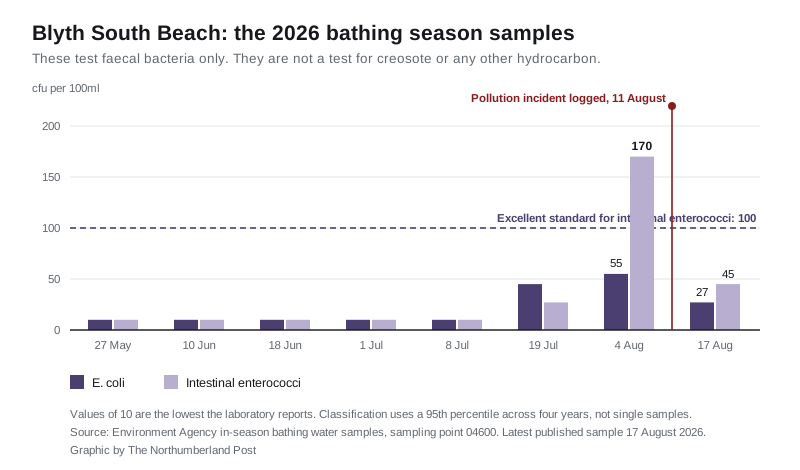
The Environment Agency samples Blyth South Beach through the bathing season, which runs from May to September. Those samples test for exactly two things: E. coli and intestinal enterococci. Both are faecal indicator bacteria, used to judge sewage and farm runoff. That is set out in the agency’s own guide to the data.
They are not a test for creosote, oil or any other hydrocarbon. A clean routine sample tells you about sewage. It tells you nothing about the contamination the agency is currently investigating.
Here is every routine sample taken at Blyth South Beach this season, from the Environment Agency’s in-season data:
| Sample date | E. coli (cfu/100ml) | Intestinal enterococci (cfu/100ml) |
|---|---|---|
| 27 May 2026 | 10 | 10 |
| 10 June 2026 | 10 | 10 |
| 18 June 2026 | 10 | 10 |
| 1 July 2026 | 10 | 10 |
| 8 July 2026 | 10 | 10 |
| 19 July 2026 | 45 | 27 |
| 4 August 2026 | 55 | 170 |
| 17 August 2026 | 27 | 45 |
For a coastal bathing water, the Excellent standard is 250 cfu/100ml or fewer for E. coli and 100 cfu/100ml or fewer for intestinal enterococci. That is measured as a 95th percentile across four years of samples, not sample by sample. On that basis the 4 August reading of 170 stands out from the rest of the season. The 17 August sample, taken six days after the incident was logged, came back at 27 and 45.
The 17 August sample was still the most recent one published when we checked on 27 August.
Short term pollution forecasts are a separate thing
The agency also publishes a daily short term pollution risk forecast for the site. That is a rainfall and tide model for sewage related bacteria, covering pollution expected to last under 72 hours. It has nothing to do with the creosote investigation.
The forecast issued on 26 August put Blyth South Beach at increased risk. It expired at 08:29 on 27 August, and a new one is published each morning, so check the live record rather than this page for today’s position.
What it means for you
If you are heading to Blyth over the bank holiday weekend, the south end of the beach is open for bathing and the north end is not. The dividing line the authorities are using is the Dave Stephens Centre. The Hole in the Wall entrance is also restricted, so plan your access from the south.
Keep dogs off the affected stretch. If you or a child have been in the water there and feel unwell, or have eye or skin irritation, get medical advice rather than waiting it out.
The council has not said how long this will last, and the investigation into the source is still running. We will update this page when the position changes.
If you are travelling to the coast this weekend, our Northumberland roadworks and travel page has what is closed on the roads, and things to do in Northumberland covers the rest of the county.
Have your say