
Defra's register records two Northumberland premises this season, and two county shows dropped sheep and goat classes. Report suspicions on 03000 200 301.
Bluetongue has been confirmed in livestock in the west of Northumberland. The county council’s Trading Standards and Animal Health Team is asking farmers and keepers to watch their stock closely and report anything suspicious immediately.
The strain is BTV-3. It is spread by biting midges, not by contact between animals, and it affects sheep, cattle, goats, deer and camelids such as alpacas and llamas. It does not affect people or food safety.
Reporting a suspicion is a legal duty rather than a choice. Bluetongue is a notifiable disease, and the number to call in England is 03000 200 301.
Two premises on the national register
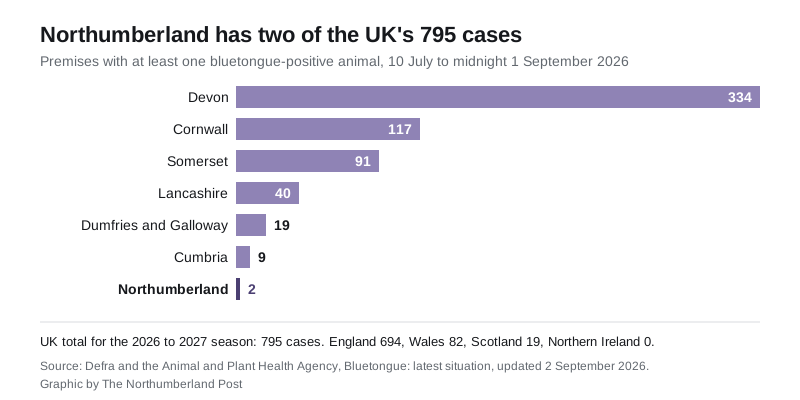
Defra and the Animal and Plant Health Agency publish a running count of confirmed cases. Their table covering 10 July to midnight on 1 September 2026 records two Northumberland premises for the 2026 to 2027 season.
The council’s statement, published on 2 September, describes it as “a first confirmed case in our county”. We could not reconcile the two figures from first-party sources today. Neither the council nor Defra gives a location beyond the west of the county.
The wider picture from the same table:
- 795 confirmed cases across the UK this season: 694 in England, 82 in Wales, 19 in Scotland and none in Northern Ireland
- 2,537 further premises in Great Britain are under investigation after reporting suspicious signs
- Devon has 334 cases, Cornwall 117 and Somerset 91, so the bulk of the outbreak is still in the south west
- Lancashire has 40, and the nearest concentration to Northumberland is 19 in Dumfries and Galloway, just over the border, with 9 in Cumbria
- 1,148 sheep and 320 cattle have been affected nationally, plus five alpacas and one llama
Defra says the true number of affected animals is likely to be significantly higher, because testing does not always cover every animal on a premises.
Two county shows dropped their sheep and goat classes
The virus has already changed the county’s show season. Councillor Gordon Stewart, the cabinet member with responsibility for public safety, said organisers “took the difficult but responsible decision to cancel the sheep and goat sections at both the Bellingham Show and the Glendale Show in Wooler to protect local livestock welfare”.
The council’s statement refers to the sheep and goat sections being cancelled, not the shows themselves. Neither society’s own website carried a notice we could read today.
If you are planning to enter or visit an autumn show with livestock classes, check with the organiser before you travel. Our things to do in Northumberland page lists what is on across the county.
What to look for
The council and Defra list overlapping sets of signs. In sheep, which usually show the disease more obviously than cattle:
- ulcers or sores in the mouth and nose
- drooling, and discharge from the eyes or nose
- swelling of the lips, tongue, head and neck, and of the coronary band above the hoof
- fever, lameness and breathing problems
- abortion, deformed lambs and stillbirths
In cattle:
- lethargy and loss of appetite
- crusty erosions around the nostrils and muzzle
- redness of the mouth, eyes and nose, and above the hoof
- reddening and erosions on the teats
- fever and a drop in milk yield
Adult cattle can be infectious for several weeks while showing little or no sign of disease, which is one reason the virus spreads before anyone sees it.
The council also warns that these signs look like other notifiable diseases, foot and mouth among them, so they need professional assessment rather than a judgement at the gate.
How to report, and what the movement rules are now
Call the APHA helpline on 03000 200 301 if you suspect bluetongue in England. Northumberland County Council’s animal health team can be reached at tradingstandards@northumberland.gov.uk for other questions.
On movements, the position is more relaxed than many keepers expect, and it turns on the fact that the whole country is already a restricted zone:
- Within England: the whole of England has been a bluetongue restricted zone since 1 July 2025. You do not need a specific bluetongue licence or a pre-movement test to move animals within England.
- To Wales: an all-Wales restricted zone came in on 10 November 2025, and livestock movements between England and Wales do not require vaccination or mitigation measures.
- To Scotland: this is the one that matters on a border county. A temporary control zone was put in place in south west Scotland on 20 August 2026. Any movement of susceptible animals from the English restricted zone into Scotland must comply with general licence EXD608(EW). Those controls came in on 1 June 2026 and Defra says they remain in force until at least 9 September 2026.
- Germinal products: you need a specific licence, and testing, to freeze semen, ova or embryos anywhere in England.
Vaccination
Three BTV-3 vaccines are authorised for use in the UK: Bluevac-3, BULTAVO 3 and Syvazul BTV 3. A vet must prescribe them, but as the keeper you can administer them yourself.
The record keeping is strict. You must record every animal you vaccinate, keep those records for at least five years, and report the vaccination within 48 hours with the individual animal IDs and the vaccine used. Using the vaccine without reporting it is against the law.
What it means for you
If you keep any ruminants or camelids, including a few pet sheep or alpacas, this applies to you. The reporting duty is not limited to commercial farms. If you see the signs above, ring 03000 200 301 rather than waiting for your vet’s next visit.
Early reporting is the point. Councillor Stewart said it is “essential to help scientists map the spread of the virus, identify the circulating strains, and implement control measures”. Defra funds diagnostic testing for up to three affected animals where suspect clinical signs are reported.
You do not need a licence to move stock within England. If you are being told otherwise, check the government guidance directly. Moving north into Scotland is the exception, and Defra guarantees the current conditions only until 9 September, so check the licence before you load.
The public is not at risk. Defra states plainly that bluetongue does not affect people or food safety.
Midges are the vector, so housing helps. Defra advises keeping animals in buildings that exclude biting midges, especially at dawn and dusk, when the midges are most active. The midge season runs from roughly April to November, and Defra recorded them becoming active again on 31 March 2026.
Sources: Northumberland County Council, Council urges vigilance following Bluetongue case in Northumberland, 2 September 2026; Defra and APHA, Bluetongue: latest situation, updated 2 September 2026; Bluetongue: how to spot and report it, updated 3 August 2026; Bluetongue: how to prevent it and stop it spreading; Bluetongue serotype 3 (BTV-3) vaccination, updated 17 March 2026.
Have your say