
All of the council's 140 commercial solar installations and 40% of 1,200 in homes stopped generating. A £4.98m fix reaches Cabinet on 8 September.
Every one of Northumberland County Council’s commercial solar panel installations has been switched off as a precaution after two fires, along with 40% of the panels on its houses. Cabinet is asked next Tuesday to approve nearly £5 million to inspect them, make them safe and turn them back on.
The detail is in a report to Cabinet on 8 September, which summarises three new capital proposals. The council has published nothing about the solar shutdown.
What happened
The council owns roughly 140 commercial and 1,200 domestic solar photovoltaic installations. Most went in between 2011 and 2019, to earn Feed-in Tariff payments, cut energy bills and reduce carbon.
Then came two fires. The report names them:
- Northburn Sports and Community Centre, June 2024
- Shanklea Primary School, July 2025. The school is Cramlington Shanklea Primary School on Nairn Road, a 266-pupil community school on the government’s register.
An Incident Management Group was set up to investigate both and decide what was needed to keep the rest of the estate running safely. Its review concluded that the council’s management and maintenance of the panels fell short of current industry best practice.
In the meantime the systems were isolated as a precaution, and they have stayed off. The report puts the current position bluntly: “At present 100% of the commercial estate and 40% of the domestic estate are not generating income.”
What it is costing
The report does not put a figure on income already lost. It says the isolation “resulted in a significant loss of FiT income and renewable energy generation”, and that the proposed works would “protect approximately £1.000 million per annum of FiT income”.
Cabinet is asked to approve two amounts:
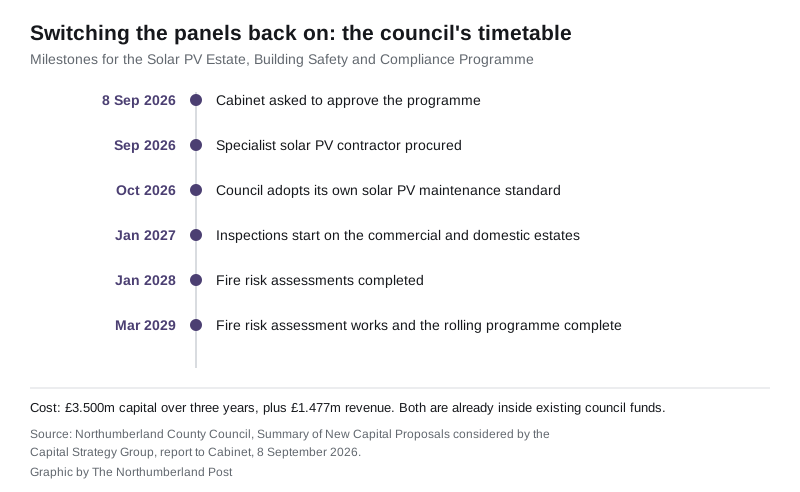
- £3.500 million of capital, split £1.500m in 2026-27, £1.000m in 2027-28 and £1.000m in 2028-29, for solar PV works and fire risk assessment remedial works across the commercial and domestic estates
- £1.477 million of revenue, split £0.505m, £0.559m and £0.413m across the same three years, for compliance staffing, contractor management, inspection and maintenance
That is £4.977 million in total. Neither figure is new money. The capital comes from the existing Property Stewardship Fund and the revenue from the Estates Rationalisation Reserve, both already in the council’s programme.
Officers looked at three options. Doing nothing was discounted as “serious failing in relation to Health and Safety”. Minimal compliance work, enough only to recommission the systems, was discounted because it would restart the income but leave the council exposed on fire safety. The recommended option is the full set of Incident Management Group and independent expert recommendations, plus passive fire safety improvements.
The report is honest that the total could grow. It lists a risk of “increased capital expenditure requirements once the work on the estate has commenced”, and says detailed cost modelling is still being developed.
Haltwhistle pool: £1.191m, and a hint about crowdfunding
The same report carries the Haltwhistle Swimming and Leisure Centre grant the council announced on 1 September. The document is more precise than the announcement.
The grant is up to £1.191 million, not £1.1m: £1.092m in 2026-27 and £0.099m in 2027-28. It breaks down as £0.818m of construction, £0.090m of professional fees and surveys, £0.084m of contingency and £0.199m of VAT. The money comes from the Borderlands Place Programme, a ten-year £21 million initiative covering seven Northumberland towns, each in line for up to £3m.
The centre has three outdoor heated pools, a sports hall, gym and fitness studio, and is run by an independent charity governed by trustees. The report gives 138,800 users a year, where the announcement said around 140,000, and says the scheme would safeguard 20.00 full time equivalent jobs. Parts of the plant room date from the original 1975 installation.
Two details the announcement left out. The VAT provision of £0.199m is a “prudent worst-case assumption”, and specialist advice is being taken on whether the charity can recover it, which would cut the grant. And the council intends to explore match funding with the charity, including “the potential for alternative methods such as crowd funding”, with anything raised reducing the council’s grant.
On timing, the report says construction starts in December 2026 and hands over in February 2027.
The Hexham workshop finally has a timetable
The third item answers a question we could not get answered when we covered the council’s £13m bin lorry programme in August. At that point the council had given no completion date for the new vehicle workshop at Tyne Mills in Hexham.
Cabinet is now asked to approve £0.450 million to appoint a multi-disciplinary design team, spread £0.200m, £0.145m and £0.105m over three years and funded from the existing Tyne Mills Depot budget.
The report also explains why a new build rather than a refurbishment. The current workshop has too little capacity for a growing fleet, poor building condition, poor welfare facilities and inadequate storage. It is a drive-in, reverse-out layout, which means reversing manoeuvres, “contrary to health and safety best practice”. The site cannot be expanded or re-orientated, so the plan is to build a six-bay workshop on the adjacent former Hexham fire station site.
The timetable in the report:
- design work to RIBA stage 3, September to November 2026
- planning submission and determination, November 2026 to April 2027
- contractor procurement, March to May 2027
- council financial approval of the contractor, July 2027
- construction, July 2027 to July 2028
A further report will go back to the Capital Strategy Group for the construction money once the design work confirms the scheme is viable. If it never proceeds, the £0.450m becomes a revenue cost charged to the Estates Rationalisation Reserve.
What it means for you
If you are a council tenant with solar panels, yours may be among the 40% that are off. The report does not say which homes are affected or when individual systems will be reconnected. The domestic inspection programme is not due to start until January 2027, and the rolling programme runs to March 2029.
The lost generation is a bill the council is carrying now. Around £1 million a year of Feed-in Tariff income is at stake, against £4.977m of spending to protect it. Both sit inside existing budgets, so this is not a new call on council tax, but it is money not available for something else. Our Northumberland council tax bands page sets out what households pay.
Haltwhistle’s pool is not closing. The works are about plant that is half a century old in places, and the stated aim is to keep the centre open. If you use it, expect construction on site from December.
West Northumberland’s council vehicles keep using the old workshop until 2028. That covers gritters and road sweepers as well as bin lorries, so it bears on winter roads. Watch for the planning application, due between November 2026 and April 2027, on our Northumberland planning news page.
You can see the papers yourself. Cabinet meets at 10am on Tuesday 8 September in the Council Chamber at County Hall, and the full agenda and reports pack are published in advance.
Sources: Northumberland County Council, Summary of New Capital Proposals considered by the Capital Strategy Group, report to Cabinet, 8 September 2026, considered by the Capital Strategy Group on 28 July 2026; and Haltwhistle pool set for a major splash of investment, 1 September 2026.
Have your say