
Cabinet backs bringing buses under public control but wants rural guarantees first. The consultation closes 9am on 28 September; first services in 2029.
Northumberland County Council has agreed to back the plan to bring the region’s buses under public control, but it will tell the North East Mayor that six things need answering first. Rural Northumberland heads the list.
Cabinet took the decision on Tuesday 8 September. Residents have until 9am on Monday 28 September to give their own view to the North East Mayoral Strategic Authority (NEMSA), which is running the statutory consultation.
What Cabinet actually decided
Councillors did not vote on franchising itself. That decision belongs to the Mayor, and it is expected in early 2027. What Cabinet agreed was how the county council would respond as a statutory consultee (printed decisions, 8 September 2026).
The resolution has three parts:
- receive and acknowledge NEMSA’s Franchising Scheme Assessment and the consultation documents
- delegate authority to the Executive Director for Place and Regeneration, working with the Deputy Leader, to submit the council’s response
- receive further reports on the consultation outcome and any later decisions
The report was brought by Councillor Richard Wearmouth, the Deputy Leader, with Simon Neilson, Executive Director for Place and Regeneration, as responsible officer.
The council’s position: supportive, with conditions
The report states that the council is “broadly supportive of the objectives of bus reform and the outcomes sought through the proposed franchising scheme”. That support is qualified. It is “subject to further assurance over affordability, governance, deliverability and outcomes for Northumberland residents, communities and businesses” (Bus Reform: Statutory Consultation, Cabinet, 8 September 2026).
The council’s response will ask NEMSA to clarify six things:
- the benefits, risks and outcomes of franchising for Northumberland residents and businesses
- the scale, timing and geographic spread of any extra investment in rural bus services
- the full cost of running a franchised network, and the financial risk to constituent councils
- how county councillors and officers would keep a meaningful say over local network planning
- how performance, accountability and decision making would work under franchising
- how the bus network could join up with home to school transport, supported transport and highways
The underlying worry is stated plainly. The assessment identifies benefits at a regional level, and the council wants to know how they land locally. Northumberland is the largest authority area in the region, with a dispersed population and, in the report’s words, a “reliance on rural transport connections”.
Northumberland’s buses are growing, against the regional trend
This is the part of the record that sits awkwardly with the case for change, and the council puts it in the report itself.
Across the North East, the network has shrunk by 32% in 15 years, a fall of 24 million miles a year. Passenger journeys are down 31%, or 52 million a year. The region still recorded 116 million bus journeys in 2024/25.
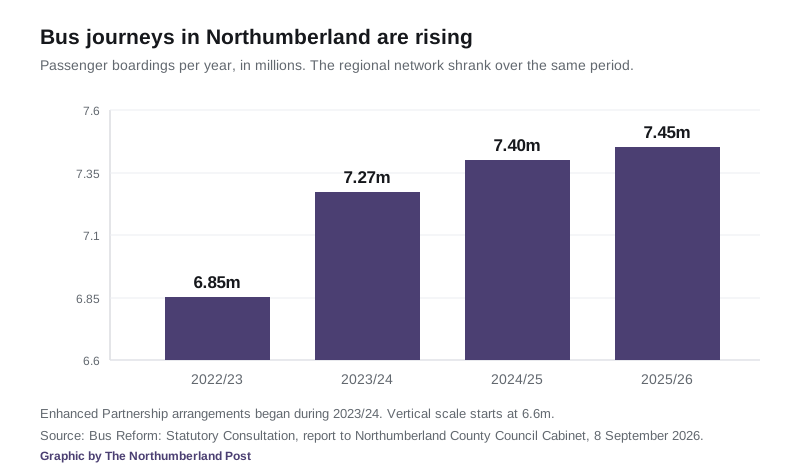
Northumberland has gone the other way. Boardings have risen every year for five years:
| Year | Passenger journeys |
|---|---|
| 2022/23 | 6.85 million |
| 2023/24 | 7.27 million |
| 2024/25 | 7.40 million |
| 2025/26 | 7.45 million |
The report credits council investment, the Bus Service Improvement Plan and partnership working with operators. The county funds roughly 68 routes, or parts of routes, that operators will not run commercially. It has a core budget of about £2.1m for those services. In recent years that has been topped up by about £3.4m a year devolved from the Department for Transport.
What franchising would change
Buses outside London were deregulated in 1986. Operators decide routes, timetables, fares and standards, and councils fill the gaps by paying for services nobody runs commercially.
Under franchising, NEMSA would set routes, timetables, fares and service standards, then buy the services from operators through competitive contracts. Mayor Kim McGuinness stood in 2024 on a promise to bring “buses back under public control”. Six other combined authorities have already chosen franchising.
The assessment assumes that, for the first ten years:
- fare rises would be capped at Retail Prices Index inflation
- network mileage would stay constant
- operators would work to a lower average profit margin than now
- fares and tickets would be simplified, with one app and website for the whole network
It assumes the opposite for the current Enhanced Partnership: fares rising above RPI, and mileage carrying on down.
The caveat worth reading twice
The modelling shows franchising delivering more miles, lower fares and more passengers than the Enhanced Partnership would. That comparison is against a declining baseline, not against today.
The report is explicit about it. Those outcomes “reflect franchising’s potential to arrest the projected decline in bus services and patronage, rather than necessarily representing an improvement against current levels in all cases”. In some cases, it says, patronage may still fall against current levels despite the extra subsidy.
Franchising also moves revenue risk onto the public sector. The regional network already leans heavily on public money: £123m in 2024/25, equal to 51% of all bus operator income.
The assessment was independently audited by Grant Thornton UK Advisory & Tax LLP, as the Transport Act 2000 requires. The auditors found the information and analysis were of sufficient quality. They also flagged forecasting uncertainty, long term funding assumptions, delivery arrangements and implementation risks, none of which changed their overall conclusion.
What it means for you
Nothing changes on your route this year, or next. The Mayor decides in early 2027, and the indicative programme would see the first franchised services running from autumn 2029.
What you can do now is respond before the deadline. The consultation closes at 9am on Monday 28 September 2026. NEMSA takes responses:
- online, through the survey on its have your say page
- by email to haveyoursay@northeast-ca.gov.uk
- by phone on 0191 277 4223
- by post to North East Mayoral Strategic Authority, The Lumen, St James’ Boulevard, Newcastle upon Tyne, NE4 5BZ
Printed copies with free return envelopes are available on request. The full consultation document runs to several hundred pages.
If you live in the north or west of the county, the council’s second question is the one that covers you: where rural investment would go, and when. That is worth saying in your own words, because the county council has told NEMSA it does not yet know the answer.
For getting around in the meantime, see our guides to trains and travel across Northumberland and current roadworks and closures.
Have your say